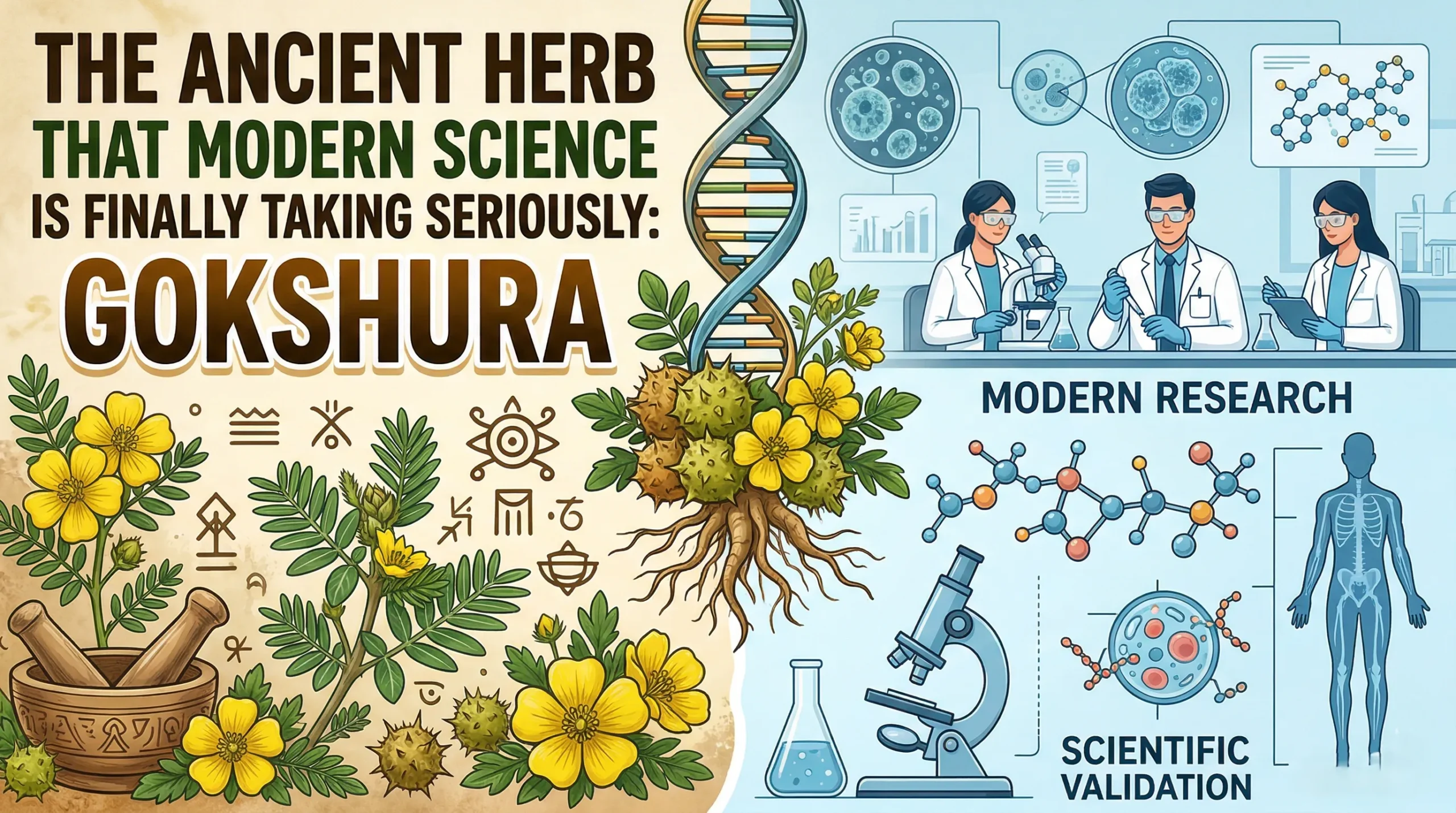
For thousands of years, Ayurvedic healers called it a gift from the earth. Today, researchers are running clinical trials to find out why they were right.
3,000+Years of use in Ayurvedic medicine
45+Active phytochemicals identified
3,000+ years of use in Ayurvedic medicine
What is Gokshura?
The name Gokshura derives from Sanskrit — go meaning cow, and kshura meaning hoof — a nod to the shape of the plant’s spiny fruit. In classical Ayurvedic texts, including the Charaka Samhita and Sushruta Samhita, Gokshura is classified as a rasayana, or rejuvenating tonic, prized for its ability to strengthen the body, support reproductive health, and nourish the kidneys and urinary system.
The plant belongs to the Zygophyllaceae family and thrives in arid, tropical climates. It is the fruit, seeds, and roots of Tribulus terrestris that hold its medicinal potency — a dense concentration of steroidal saponins (primarily protodioscin), flavonoids, alkaloids, and tannins that together create its wide-ranging therapeutic profile.
“Gokshura does not target one system — it restores balance across many. That is the Ayurvedic philosophy of a true rasayana.”
The Science Behind the Tradition
For decades, Western pharmacology was skeptical of plant-based tonics. That skepticism has gradually given way to a more nuanced appreciation, particularly as researchers began isolating the bioactive compounds in Gokshura and testing their mechanisms in controlled studies.
Research spotlight:
Studies published in peer-reviewed journals including Phytomedicine and the Journal of Ethnopharmacology have documented Gokshura's diuretic, anti-inflammatory, and adaptogenic properties.

Research on protodioscin — the primary saponin in Gokshura — suggests it may support hormonal signalling pathways, including luteinizing hormone (LH), which plays a central role in testosterone and estrogen regulation in both men and women.

Additional studies have identified antioxidant activity, ACE-inhibiting effects relevant to blood pressure, and anti-urolithic (kidney stone-preventive) properties in aqueous and ethanolic extracts of the plant.
What makes Gokshura particularly interesting from a scientific standpoint is its pleiotropic nature — meaning it acts on multiple biological targets simultaneously. This is relatively uncommon in synthetic pharmacology, making Gokshura a subject of genuine curiosity among researchers studying systems biology and whole-body wellness.
Six Key Benefits Supported by Research
Hormonal Balance
Protodioscin may support healthy testosterone and LH levels in men, and reproductive hormone balance in women — without acting as a direct hormone.
Vitality & Performance
Used traditionally to build ojas (vital energy), modern research supports its role in stamina, muscle recovery, and reducing exercise-induced fatigue.
Kidney & Urinary Health
Its diuretic and anti-urolithic properties support a healthy urinary tract and may help prevent kidney stone formation.
Anti-Inflammatory Action
Flavonoids and saponins inhibit pro-inflammatory mediators, relevant for joint health, muscle soreness, and systemic inflammation.
Stress Adaptation
As an Ayurvedic rasayana, Gokshura helps the body adapt to physical and mental stress — a property studied under the lens of adaptogen science.
Cardiovascular Support
Early research into Gokshura’s ACE-inhibiting activity suggests a potential role in supporting healthy blood pressure and heart function.
Gokshura for Men vs. Women
One reason Gokshura has endured across traditions is its relevance to both male and female wellness, though through different pathways. In men, the primary interest lies in its potential to support testosterone levels, libido, and athletic recovery. In women, Gokshura has long been used to support reproductive health, ease symptoms of hormonal transition, and restore vitality following periods of depletion.
Importantly, Gokshura is not a hormone. It does not introduce exogenous hormones into the body. Instead, it appears to work through endocrine signalling — gently nudging the body’s own hormonal systems toward equilibrium. This makes it a particularly appealing option for those seeking hormonal support without the side effects associated with synthetic interventions.
How to Take Gokshura
Traditionally, Gokshura was taken as a decoction — simmered in water or milk — or as a fine powder (churna) mixed with warm water and honey. Today it is available in standardised capsule and tablet form, making consistent dosing far more accessible.
At Swalys, our Gokshura formulations are standardised to 40% saponins and sourced from certified organic farms in Rajasthan, ensuring potency, purity, and traceability in every batch. The recommended daily intake typically ranges from 250–500 mg of standardised extract, ideally taken with meals. We recommend consulting a practitioner before beginning any new supplement regimen.
“In Ayurveda, the goal is not to override the body — it is to restore its capacity to heal itself. Gokshura is a master of that art.”
The Swalys Perspective
At Swalys, we are not interested in wellness trends. We are interested in what works — what has been proven across generations of human experience and is now being validated by the rigour of modern science. Gokshura represents everything we stand for: deep roots in tradition, honest engagement with evidence, and a genuine commitment to helping people feel their best.
The ancient texts were not wrong about Gokshura. They simply did not have the tools to explain why. Now we do — and that conversation between old wisdom and new knowledge is exactly where the most meaningful wellness advances are happening.
This thorny little plant has waited a long time for its moment. We think it has more than earned it.
Disclaimer: This article is for informational purposes only and does not constitute medical advice. Statements have not been evaluated by any regulatory authority. Swalys products are not intended to diagnose, treat, cure, or prevent any disease. Please consult a qualified healthcare practitioner before beginning any new supplement.
 Third-Party Lab Tested for Purity